
China Panel Sourcing in 2026: Certification, Capacity and Lead Time
Three questions decide most panel purchases: does the board carry the papers my project needs, can the mill actually deliver the volume, and when will it arrive. In a year when freight schedules and certification requirements both keep moving, the answers are best read off the manufacturer's own published data rather than a broker's summary. Dongstar Group publishes its certification set, its sheet formats and its production windows from Linyi city, and those three fields are enough to build a realistic buying plan.

Key takeaways
- Certification is a set, not a badge: ISO, CE, CARB and FSC each cover a different risk, and only some of them apply to the board you are buying.
- Capacity claims without numbers are the norm in this industry — test them with production scheduling questions instead of asking for a figure.
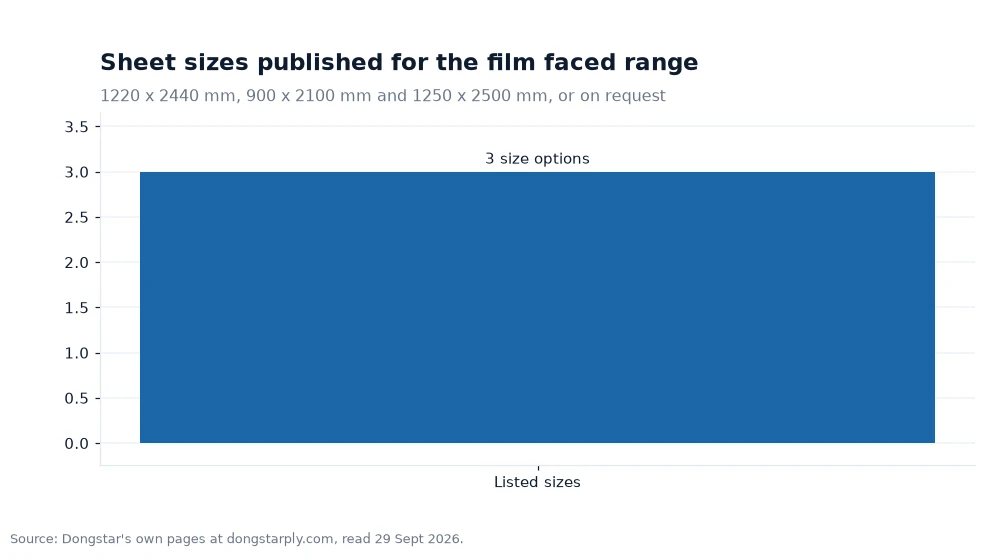
- Film faced panels are published in three sheet formats, 1220 × 2440 mm, 900 × 2100 mm and 1250 × 2500 mm, which sets the cutting plan before price is discussed.
- Lead times of two to ten weeks after deposit on structural panels, or fifteen to twenty-five days on standard beams, are the planning numbers to carry into a tender.
What a 2026 panel buyer is actually comparing
Five years ago most first enquiries asked for a price per sheet. Today the useful ones ask for a specification, a document set and a production slot, in that order. The reason is simple arithmetic: price per sheet only becomes comparable once sheet size, thickness and grade are fixed, and the documentation question has to be answered before a European or North American site will accept a delivery at all.
That shifts the work forward. A buyer who settles the specification first can price three suppliers against the same board. A buyer who prices first usually ends up comparing two different products and choosing on a number that has no meaning. The published data from Dongstar Group makes the ordering easier, because the ranges are printed rather than negotiated.
Certification: one set, four different jobs
The film faced range and the fibreboard range both name ISO, CE, CARB and FSC. Those four documents do not overlap. CE is the market-access paper a European specifier needs before a panel can be placed in a structure. CARB speaks to formaldehyde limits for interior products sold in North America, with the panel ranges also published in E0 and E1 classes. FSC traces the timber to responsibly managed sources. ISO is a management-system statement, useful for audit trails but not a product test.
Read one product at a time. Ask, in writing, which of the four applies to the exact board on the quotation, and how the formaldehyde class is documented if the end use is interior furniture. Answers that name the product, the class and the issuing scope are the sign of a supplier who has been through the exercise before.
| Question | Document that answers it | Typical end use it unlocks |
|---|---|---|
| Can this panel go into a structure in Europe? | CE | Formwork and structural sheathing |
| Does the timber trace to a managed forest? | FSC | Projects with procurement policies |
| Is the formaldehyde class acceptable for interiors? | CARB, plus E0 or E1 classes | Furniture, cabinets, fitted interiors |
| Is there a management system behind the paperwork? | ISO | Audits and supplier approval files |
Capacity: how to test it without a number
Most Chinese panel producers describe capacity in words rather than digits — a state-of-the-art production plant, advanced machinery, large production capacity — and that is exactly what the Dongstar Group pages say. No output figure, no headcount, no floor area. Rather than treat the omission as a problem, treat it as a prompt: capacity is best tested through scheduling behaviour.
Four questions do most of the work. How many shifts are running when the order is placed? Which lines can press the thicknesses in my specification? How far ahead is the next free production window? And on customised items, can the mill produce to my brand or a special face? The formwork beam pages answer that last question directly, offering OEM and ODM work and describing samples for first orders, which is a reasonable proxy for how flexible the wider plant is — and a fair test of whether a Plywood Supplier can be scheduled rather than merely quoted.
Lead time: the number to plan a project around
Published windows matter more than optimistic ones because a tender has to survive them. Dongstar states two to ten weeks from order confirmation and deposit on the structural three-ply range, with scheduled shipments available on longer contracts, and a minimum of one 20-ft container or its equivalent for wholesale orders. The formwork beam line quotes fifteen to as a rule, twenty-five days for standard orders plus twenty to thirty days for customised as standard beams.
Add transits to those figures and the shape of a project becomes visible. A buyer who plans against ten weeks will usually be early; a buyer who plans against two weeks will not be late only by luck. It also pays to check how long the documents take. A CE file and an FSC statement that are issued with the shipping documents keep a delivery moving at the port, while paperwork that arrives late can hold a container in a yard for longer than the production run took.
Worked example: pricing three published sheet formats
Suppose the enquiry covers three sheets, one of each published format, and the buyer wants to know the total surface being specified. The smallest format is 0.9 m × 2.1 m = 1.89 m² (example). The 4 × 8 sheet is 1.22 m × 2.44 m = 2.98 m² (example). The largest is 1.25 m × 2.5 m = 3.125 m² (example). Added together: 1.89 + 2.98 + 3.125 = 7.995 m², or 8.0 m² to the nearest decimal (example).
Now scale that to a tender of 1,000 sheets in the 4 × 8 format: 1,000 × 2.98 = 2,980 m² of panel. The same count in the 1250 × 2500 mm format gives 1,000 × 3.125 = 3,125 m², a difference of 145 m² for the same sheet count (example). On a formwork job that gap is roughly the wall area of a small apartment — the kind of number that should decide the format before the price is negotiated, not after.
Frequently asked questions
Which certificate should a European importer ask for first?
CE documentation, because it is the market-access requirement for structural use. Then confirm the formaldehyde class if the panels will end up in interior furniture, and the FSC chain if the project has a procurement policy.
Why do Chinese panel suppliers not publish capacity figures?
Because industry convention is to describe plant and machinery qualitatively. Ask about shift patterns, free production windows and custom-brand capability instead, and judge capacity from how precisely those scheduling questions are answered.
How early should a panel order be placed for a 2026 project?
Work backwards from site delivery. Two to ten weeks of production after deposit, plus ocean transit, plus document turnaround gives a planning window of roughly three months for a first container from a new supplier.
Two more pages worth reading first
For project buyers, the structural three-ply specification sets out the minimum order, the production window and the trade terms in one place, while the formwork beam pages show the other end of the same schedule — standard beams in fifteen to twenty-five days against twenty to thirty days for customised runs. Both are worth reading before a tender deadline rather than after.
Certification sets, sheet formats, minimum order quantities and production windows quoted in this article come straight from that company's own pages, read 29 Sept 2026, as the source for the table above, as the basis for this guide[1].